
 By gold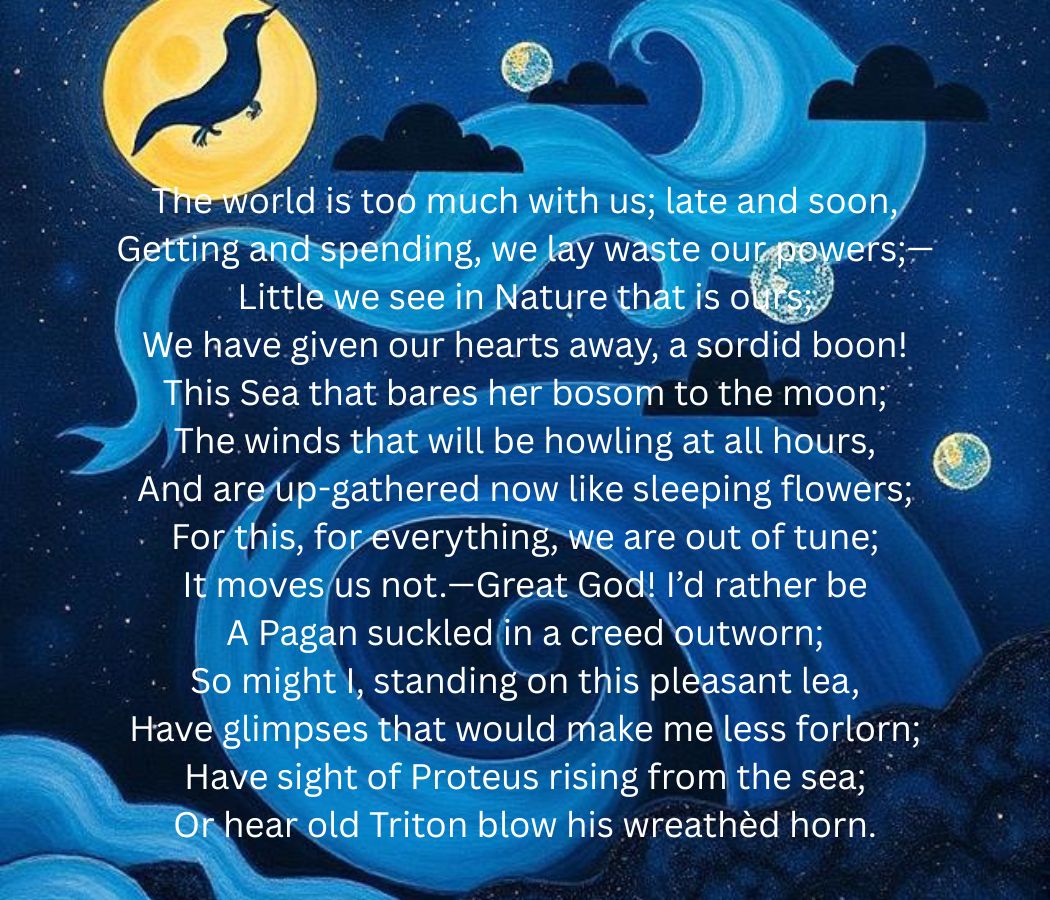
Before we sleep, we scroll. At dinner, we check emails. And in between, we measure our worth by output, our happiness by likes, and our time by dollars
William Wordsworth saw us coming—and he wept.
In 1807, during the First Industrial Revolution, Wordsworth penned a furious little sonnet titled “The World Is Too Much With Us.” Two centuries later, it isn’t a dusty museum piece. It’s a diagnosis.
Let’s break down the poem, its hidden meaning, and why it might be the most urgent environmental and spiritual critique of our age.
The Full Poem (1807 Version)
Before we analyze, read it aloud. Hear the anger.
The world is too much with us; late and soon,
Getting and spending, we lay waste our powers;—
Little we see in Nature that is ours;
We have given our hearts away, a sordid boon!
This Sea that bares her bosom to the moon;
The winds that will be howling at all hours,
And are up-gathered now like sleeping flowers;
For this, for everything, we are out of tune;
It moves us not.—Great God! I’d rather be
A Pagan suckled in a creed outworn;
So might I, standing on this pleasant lea,
Have glimpses that would make me less forlorn;
Have sight of Proteus rising from the sea;
Or hear old Triton blow his wreathèd horn.
The Core Conflict: Getting, Spending, and Numbness
The opening line is a blunt hammer: “The world is too much with us.”
Wordsworth doesn’t mean the natural world. He means the human world—the world of commerce, status, debt, schedules, and transactions. In his time, factories were swallowing fields. Today, screens have swallowed our attention.
“Getting and spending, we lay waste our powers.”
That’s the thesis. We exhaust our energy not on living, but on acquiring. We are tired not from walking the moors, but from the treadmill of more.
The result? “Little we see in Nature that is ours.” We stand before a sunset and think, What filter would make this better? We walk a forest trail and check our step count. Nature becomes a backdrop, not a participant.
Wordsworth’s diagnosis is spiritual atrophy: “We have given our hearts away, a sordid boon!” (A “boon” is a blessing, but “sordid” means filthy. We sold our souls for cheap comfort.)
The Ecological Warning: “It Moves Us Not”
Read lines 5–8 again:
This Sea that bares her bosom to the moon;
The winds that will be howling at all hours…
For this, for everything, we are out of tune;
It moves us not.
This is radical for 1807. Nature is not a resource to be logged, mined, or dammed. It is a living presence—the sea as a woman, the winds as howling creatures. But we have become “out of tune” with it.
Sound familiar? We call it “eco-anxiety” or “climate grief.” Wordsworth called it disconnection.
When a hurricane destroys a coast, we react with economics (“rebuilding costs”) rather than awe. When a species goes extinct, we scroll past. It moves us not.
That is the quiet tragedy of the poem.
The Shocking Turn: “I’d Rather Be a Pagan”
Here’s where Wordsworth gets dangerous.
Great God! I’d rather be
A Pagan suckled in a creed outworn…
A devout Christian poet (Wordsworth was deeply spiritual) announces he’d prefer ancient Greek paganism to modern Christianity—because at least pagans felt something.
The “creed outworn” is ironic. He’s not rejecting faith. He’s rejecting a faith that has become mechanical, moralistic, and nature-blind.
He wants to see Proteus (the shape-shifting sea god) rising from the waves. He wants to hear Triton (the merman herald of Neptune) blow his conch horn.
Why? Not for superstition. For wonder.
Wordsworth is saying: I would rather believe in a living, wild, dangerous ocean god than sit in a pew and feel nothing while the real ocean dies.
That is the secret punch of the poem. Materialism kills wonder. And without wonder, we destroy what we do not love.
Why This Poem Is Viral Again (Modern Parallels)
In the last five years, searches for “The World Is Too Much With Us analysis” have spiked on Reddit, YouTube, and academic forums. Three reasons why:
-
The Burnout Economy – “Getting and spending” is the gig economy, the side hustle, the 2 AM Slack ping. We are exhausted.
-
Digital Numbness – We see breathtaking nature on TikTok and scroll past. The real mountain is less interesting than the one on our feed.
-
Ecological Grief – We feel the loss of coral reefs, ancient forests, and clear skies. But the feeling is helpless. Wordsworth’s anger gives it a voice.
He doesn’t offer a solution. He offers a diagnosis and a longing. Sometimes, that’s the first step.
How to Apply the Poem to Your Life (3 Practices)
You don’t need to become a Pagan. But you can become more tuned in.
1. The “No Getting, No Spending” Hour
One hour a week, go outside without your phone, wallet, or any goal. No photography, no foraging. No exercise tracking. Just be with the wind, the sea, or the tree in your backyard.
2. Learn One Myth
Read the story of Proteus or Triton. Better yet, learn a local indigenous story about a river or mountain in your area. Mythic thinking rewires your relationship to place.
3. Write Your Own Sonnet
Wordsworth wrote his complaint as a poem. You can too. Start with: “The world is too much with me when…” It’s a powerful journaling prompt.
Final Thought: The Horn Still Blows
Triton’s horn hasn’t fallen silent. We’ve just stopped listening.
Wordsworth ends with an auditory image—a horn blown over the waves. It’s a call to attention, an alarm, and a melody all at once.
The next time you feel overwhelmed by the news, the workload, the endless scroll, go to a window. Look at the sky. The wind is still howling. The sea still bares her bosom to the moon.
FAQs: “The World Is Too Much With Us”
Below are the most commonly asked questions about Wordsworth’s sonnet, answered with depth for students, book clubs, and curious readers.
1. What is the main message of “The World Is Too Much With Us”?
Answer: The poem’s core message is that human materialism and consumerism have destroyed our emotional and spiritual connection to nature. Wordsworth argues that by focusing on “getting and spending” (money, status, possessions), we have “given our hearts away” and become numb to the natural world’s beauty and power. The poem is a warning: when we treat nature as a resource rather than a living presence, we lose part of our own humanity.
2. What does “the world is too much with us” mean?
Answer: The phrase means that human society—with its demands, transactions, schedules, and distractions—overwhelms and consumes us. “The world” here does not mean the planet or nature. It means the man-made world of commerce, industry, and social obligation. We are so buried in “late and soon” (constantly, without rest) that we have no room left for silence, wonder, or genuine relationship with the natural world.
3. Why does Wordsworth say he would rather be a Pagan?
Answer: Wordsworth says this as a shocking provocation. He was a devout Christian, but he felt that Christianity (in its institutional, industrialized form) had become too abstract and moralistic—divorced from the raw, visceral awe of nature. Pagans, by contrast, believed in literal sea gods (Proteus, Triton) and felt nature as alive, dangerous, and sacred. He is not rejecting God; he is saying: I would rather believe in a living ocean god and feel wonder, than believe in the right creed and feel nothing.
4. What does “sordid boon” mean in the poem?
Answer: A “boon” is a blessing or gift. “Sordid” means filthy, shameful, or morally degraded. So a “sordid boon” is a gift that is actually dirty or corrupting. Wordsworth uses an oxymoron to say: we think our material wealth and convenience are blessings, but they have cost us our hearts. We traded our capacity for awe for cheap comfort. That trade is the “sordid boon.”
5. Who are Proteus and Triton?
Answer: Two figures from Greek mythology:
-
Proteus is an early, shape-shifting sea god who can foretell the future but only if you can catch him and hold on through his transformations. He represents the elusive, changing, untamable power of nature.
-
Triton is the son of Poseidon (Neptune), often depicted as a merman who calms or raises the waves by blowing a conch-shell horn. His horn is a call to attention—an alarm, a summons, or a song.
Wordsworth wishes he could see them rising from the real sea because that would mean he felt the ocean as alive and divine again.
6. What literary devices are used in the poem?
Answer: Key devices include:
-
Apostrophe – Addressing an absent or abstract listener (“Great God!”).
-
Personification – The sea “bares her bosom,” winds are “howling,” flowers “sleeping.”
-
Oxymoron – “Sordid boon” (filthy blessing).
-
Alliteration – “Getting and spending,” “lay waste,” “pleasant lea.”
-
Irony – A Christian poet claiming to prefer pagan belief.
-
Volta (turn) – The poem shifts dramatically at line 9 (“Great God!”), moving from observation to passionate wish.
The poem is a Petrarchan (Italian) sonnet: 14 lines, octave (first 8 lines) presenting a problem, followed by a sestet (last 6 lines) offering a resolution or emotional turn.
7. Is “The World Is Too Much With Us” an environmental poem?
Answer: Yes—though written 150 years before the modern environmental movement. It is proto-environmental or romantic ecological. Wordsworth does not talk about pollution or extinction (unknown concepts in 1807), but he diagnoses the root cause of environmental destruction: emotional disconnection from nature. Modern eco-critics read this poem as a foundational text for “nature-deficit disorder” and the psychology behind climate inaction. If nature “moves us not,” we will never protect it.
8. What is the tone of the poem?
Answer: The tone shifts from frustrated and mournful (lines 1–8) to angry and desperate (line 9: “Great God!”) and finally to longing and wistful (the final three lines about Proteus and Triton). Overall, the tone is romantic anguish—the sadness of someone who sees beauty dying and feels powerless to wake others up.
9. How does this poem relate to modern life?
Answer: Directly and painfully. “Getting and spending” describes the gig economy, social media monetization, side hustles, and consumer debt. “Little we see in Nature that is ours” describes taking photos of landscapes without ever being present. “It moves us not” describes scrolling past climate disasters. The poem is now quoted in mindfulness blogs, burnout recovery articles, and environmental humanities courses because Wordsworth predicted the spiritual exhaustion of capitalism.
10. What is the best study guide or analysis for this poem?
Answer: For students, the best starting points are:
-
Poetry Foundation (full text + brief notes)
-
LitCharts (detailed line-by-line translation and themes)
-
GradeSaver (essay questions and quizzes)
-
YouTube – Search “The World Is Too Much With Us analysis” for video breakdowns (Dr. Adam Walker’s channel is excellent)
For academic depth, see Jonathan Bate’s Romantic Ecology or James McKusick’s Green Writing.
11. What meter is the poem written in?
Answer: Iambic pentameter (five “da-DUM” beats per line), with some variations for emphasis. For example:
The WORLD | is TOO | much WITH | us LATE | and SOON
The sonnet form gives the poem a tight, argumentative structure—like a lawyer making an emotional closing statement.
12. Can I use this poem in a wedding or memorial reading?
Answer: Yes, with caution. It is not a happy poem, but its themes of reconnection and lament can be powerful. For a wedding, use it if the couple met through nature or are environmentalists—but pair it with a hopeful counter-poem. For a memorial (especially someone who loved the outdoors), the longing for Proteus and Triton can be a beautiful expression of grief: we wish they were still here to show us wonder.